Series summation of rational function with quadratic denominator
The goal of this page is to consider infinite series summations of the form:

where the denominator function is nonzero for all summands.
Our overall goal is as follows:
- Identify some situations where there exist closed-form expressions for the solutions, and find the solutions in those cases.
- For the remaining situations, find good upper and lower bounds on the infinite summation.
Case of denominator having linear factors that differ by a nonzero integer
In this case, we can use additive telescoping to get an explicit expression for the series sum. Explicitly, consider a summation:

Each summand can be written as:

We can now telescope the partial sums and take the limit. The final answer is:

Note that we have converted an infinite sum problem to adding up a finite number of fractions. With explicit numerical values of , we can calculate the answer explicitly.

Case of denominator a perfect square
Here, we are considering a summation of the form:

Doing this in general is hard. However, there is a useful fact:
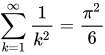
Using this fact, we can tackle the case , and more generally, any situation where is an integer. A little manipulation of the fact gives us that:


This allows us to tackle the case where is half of an odd integer.
Case of denominator having linear factors that differ by half an odd integer
Not all these cases can be handled, but some can, using a clever trick.
Consider:

The terms can be written as:

The summation explicitly is:

If we rearrange parentheses a bit (without affecting the overall order of addition), we get:
![{\displaystyle 4\left[1-{\frac {1}{2}}+{\frac {1}{3}}-{\frac {1}{4}}+\dots \right]}](https://wikimedia.org/api/rest_v1/media/math/render/svg/22ce01c73c9e68783927899d27e34742db230aa4)
The inner summation is well known for being , so we get:


Note that although the inner summation (after we've dropped the parentheses) is only conditionally convergent, the original summation is something that we know is absolutely convergent.