Taylor series operator is multiplicative: Difference between revisions
No edit summary |
(→Proof) |
||
| Line 32: | Line 32: | ||
We now want to multiply these Taylor series. To do this, we need to determine the coefficient of <math>(x - x_0)^n</math> in the product. | We now want to multiply these Taylor series. To do this, we need to determine the coefficient of <math>(x - x_0)^n</math> in the product. | ||
<math>(x - x_0)^n</math> can arise in the product by picking a factor <math>(x - x_0)^k</math> from the Taylor series of <math> | <math>(x - x_0)^n</math> can arise in the product by picking a factor <math>(x - x_0)^k</math> from the Taylor series of <math>g</math> and a factor <math>(x - x_0)^{n-k}</math> from the Taylor series of <math>f</math>. The coefficient arising from such a product is <math>\frac{f^{(n-k)}(x_0)g^{(k)}(x_0)}{(n - k)!k!}</math>. The overall coefficient is thus: | ||
<math>\mbox{Coefficient of } (x - x_0)^n = \sum_{k=0}^n \frac{f^{(k)}(x_0)g^{( | <math>\mbox{Coefficient of } (x - x_0)^n = \sum_{k=0}^n \frac{f^{(n-k)}(x_0)g^{(k)}(x_0)}{(n - k)!k!}</math> | ||
Multiply and divide the right side by <matH>n!</math> to get: | Multiply and divide the right side by <matH>n!</math> to get: | ||
<math>\mbox{Coefficient of } (x - x_0)^n = \frac{1}{n!} \sum_{k=0}^n \frac{n!}{k!(n- k)!} f^{(k)}(x_0)g^{( | <math>\mbox{Coefficient of } (x - x_0)^n = \frac{1}{n!} \sum_{k=0}^n \frac{n!}{k!(n- k)!} f^{(n-k)}(x_0)g^{(k)}(x_0)</math> | ||
We have that <math>\frac{n!}{k!(n- k)!} = \binom{n}{k}</math>, and we get: | We have that <math>\frac{n!}{k!(n- k)!} = \binom{n}{k}</math>, and we get: | ||
<math>\mbox{Coefficient of } (x - x_0)^n = \frac{1}{n!} \sum_{k=0}^n \binom{n}{k} f^{(k)}(x_0)g^{( | <math>\mbox{Coefficient of } (x - x_0)^n = \frac{1}{n!} \sum_{k=0}^n \binom{n}{k} f^{(n-k)}(x_0)g^{(k)}(x_0)</math> | ||
Now, using <math>(\dagger)</math>, we get that: | Now, using <math>(\dagger)</math>, we get that: | ||
Revision as of 16:07, 4 July 2012
Statement
Suppose and are functions defined on subsets of the reals such that is a point in the interior of the domain of both, and both and are infinitely differentiable at . Then, the pointwise product of functions is also infinitely differentiable at . Further, the Taylor series of at is the product of the Taylor series of at and the Taylor series of at .


Related facts
Facts used
- Product rule for higher derivatives: This states that wherever the right side makes sense.

Proof
Given: and are functions defined on subsets of the reals such that is a point in the interior of the domain of both, and both and are infinitely differentiable at .
To prove: The pointwise product is infinitely differentiable at and its Taylor series at is the product of the Taylor series of at and the Taylor series of at .
Proof: By Fact (1), we have:

with equality holding wherever the right side makes sense. Since the right side always makes sense, so does the left side, so is infinitely differentiable.
We recall the expressions for the Taylor series:


We now want to multiply these Taylor series. To do this, we need to determine the coefficient of in the product.

can arise in the product by picking a factor from the Taylor series of and a factor from the Taylor series of . The coefficient arising from such a product is . The overall coefficient is thus:


Multiply and divide the right side by to get:


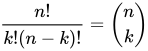
We have that , and we get:

Now, using , we get that:


So the product of the Taylor series for and is:

Since is a dummy variable, it can be replaced by the dummy variable , giving:


This is precisely the Taylor series for , and we have completed the proof.