Sinusoidal function
Definition
As a linear transform of the sine function
The term sinusoidal function refers to a function of the form where and are linear functions and is the sine function. Specifically, it is a function of the form:


Here:
- is the mean value about which the function is oscillating, i.e., the graph of a function looks like a scaled sine function about the horizontal line .
- is the amplitude of oscillations, i.e., the function oscillates between a minimum value of and a maximum value of .
- is the angular frequency parameter and controls the period of oscillations, which is given by .
- is a phase parameter that roughly describes the head start of the function relative to a function that starts at its mean value at .


As a linear combination of sine and cosine functions
The term sinusoidal function can be used for a function of the form:

Conversion between the two versions
Here's how we convert the linear combination version to the linear transform version:
- remain the same.
- Set .
- Set as an angle so that and . is uniquely determined up to additive multiples of .

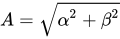


Here's how we convert the linear transform version to the linear combination version:
- remain the same.
- .
- .

