Quadratic function: Difference between revisions
No edit summary |
|||
| Line 135: | Line 135: | ||
Since the second derivative is a constant (as we find using either of the computational methods above), all higher derivatives are zero. | Since the second derivative is a constant (as we find using either of the computational methods above), all higher derivatives are zero. | ||
==Integration== | |||
===First antiderivative=== | |||
We can use that [[indefinite integration is linear]] to convert this to a problem of integrating power functions: | |||
<math>\int (ax^2 + bx + c) \, dx = a \int x^2 \, dx + b \int x^1 \, dx + c \int x^0 \, dx</math> | |||
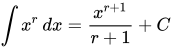
We can now use the [[integration rule for power functions]] (<math>\int x^r \, dx = \frac{x^{r+1}}{r + 1} + C</math>) and obtain: | |||
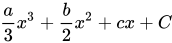
<math>\int (ax^2 + bx + c) \, dx = a \frac{x^3}{3} + b \frac{x^2}{2} + cx + C, C \in \R</math> | |||
===Higher antiderivatives=== | |||
The process of integration can be repeated. The following is the formula for the <math>k</math>-fold integral of the function: | |||
<math>a \frac{x^{k+2}2!}{(k + 2)!} + b \frac{x^{k+1}}{(k + 1)!} + c \frac{x^k}{k!} + \mbox{arbitrary polynomial of degree at most } k - 1</math> | |||
The arbitrary polynomial of degree at most <math>k - 1</math> is parameterized by <math>k</math> coefficients. These are the constants of integration that accumulate, one in each step of integration. | |||
Revision as of 03:19, 26 May 2014
Definition
A quadratic function is a function of the form:

where are real numbers and . In other words, a quadratic function is a polynomial function of degree two.


Unless otherwise specified, we consider quadratic functions where the inputs, outputs, and coefficients are all real numbers.
Related notions
- Quadratic function of multiple variables
- L1-regularized quadratic function
- L1-regularized quadratic function of multiple variables
Key data
| Item | Value |
|---|---|
| Default domain | all real numbers, i.e., all of |
| range | Case : Case : |
| period | not a periodic function |
| local maximum value and points of attainment | Case : No local maximum value Case : local maximum value is attained at point . |
| local minimum value and points of attainment | Case : local minimum value is attained at point . Case : no local minimum value |
| points of inflection | None |
| derivative | The linear function |
| second derivative | The constant function with constant value |
| derivative | The first and second derivative are as described above. All higher derivatives are zero. |
| antiderivative | with . |
| important symmetry | The graph of the function has mirror symmetry about the line (the vertical line through the unique critical point) |
| interval description based on increase/decrease and concave up/down | Case : increasing and concave down on decreasing and concave down on Case : decreasing and concave up on increasing and concave up on |
| power series and Taylor series | The power series is the same as the polynomial, i.e., the power series about any point simplifies to the polynomial (written in increasing order of powers of as ) |


![{\displaystyle \left(-\infty ,c-{\frac {b^{2}}{4a}}\right]}](https://wikimedia.org/api/rest_v1/media/math/render/svg/1721eacfac93cc6efcb5216a775451999ea23f73)




![{\displaystyle \left(-\infty ,{\frac {-b}{2a}}\right]}](https://wikimedia.org/api/rest_v1/media/math/render/svg/8c278d24b40c7c375dbd4df6c61cb318d59ab9ea)


Key invariants
| Expression | Name | Significance in the case |
|---|---|---|
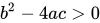
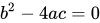
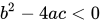
| (unnormalized) discriminant | The discriminant is positive (i.e., ) iff the quadratic has two distinct real roots The discriminant is zero (i.e., ) iff the quadratic has a real root of multiplicity two The discriminant is negative (i.e., ) iff the quadratic has no real roots | |
| leading coefficient | Leading coefficient is positive (i.e., ) iff the function approaches infinity as and as Leading coefficient is negative (i.e., ) iff the function approaches infinity as and as | |
| sum of roots | If the roots are (counted with multiplicity, and they need not be real roots), then the polynomial is and the sum of roots is . | |
| product of rots | If the roots are (counted with multiplicity, and they need not be real roots), then the polynomial is and the product of roots is . | |
| normalized discriminant | Similar observations as for the discriminant. |




Transformation
Any quadratic function can be expressed as a composite of a linear function, the square function, and another linear function. Explicitly, we can write:

In other words, it is a composite of three functions:


Differentiation
First derivative
Computation as a linear combination of monomials
We can differentiate the polynomial termwise, using the fact that it is a linear combination of monomials:

Now, using the differentiation rule for power functions, namely , we obtain:


Computation using the transformed expression
We rewrote the polynomial as:
We differentiate:

The second expression, being constant, differentiates to zero. The first expression is a composite of and the square function. We can use the chain rule for differentiation to differentiate it. The answer we obtain is:

![{\displaystyle {\frac {d}{dx}}(ax^{2}+bx+c)=a\left[2\left(x-{\frac {-b}{2a}}\right)\right]}](https://wikimedia.org/api/rest_v1/media/math/render/svg/5859b6391905a958568b3f7cc27a1621ff96658f)
Simplifying this, we get:

Second derivative
Computation as a linear combination of monomials
We can differentiate the polynomial termwise, using the fact that it is a linear combination of monomials:

Now, using the differentiation rule for power functions, namely , we obtain:


Computation using the transformed expression
We rewrote the polynomial as:
We differentiate:

We get the answer:

Higher derivatives
Since the second derivative is a constant (as we find using either of the computational methods above), all higher derivatives are zero.
Integration
First antiderivative
We can use that indefinite integration is linear to convert this to a problem of integrating power functions:

We can now use the integration rule for power functions () and obtain:

Higher antiderivatives
The process of integration can be repeated. The following is the formula for the -fold integral of the function:


The arbitrary polynomial of degree at most is parameterized by coefficients. These are the constants of integration that accumulate, one in each step of integration.
