|
|
| Line 1,229: |
Line 1,229: |
|
| |
|
| <center>{{#widget:YouTube|id=qBjqc78KGx0}}</center> | | <center>{{#widget:YouTube|id=qBjqc78KGx0}}</center> |
| | |
| | Full timed transcript: <toggledisplay> |
| | 0:00:15.940,0:00:20.740 |
| | Vipul: In this talk, I'm going to give definitions |
| | of one-sided limits. |
| | |
| | 0:00:20.740,0:00:25.650 |
| | So it is going to be the left hand limit and |
| | the right hand limit, and I'm going to basically |
| | |
| | 0:00:25.650,0:00:42.650 |
| | compare it with the definition of two-sided limit which was in |
| | a previous video. Let's just write this down--left-hand limit. |
| | |
| | 0:00:44.110,0:00:48.679 |
| | Let me first remind you what the definition |
| | of two-sided limit says. |
| | |
| | 0:00:48.679,0:00:57.679 |
| | So here's what it says. It says limit as x approaches |
| | c, f(x) = L |
| | |
| | 0:00:58.469,0:01:03.140 |
| | so f has to be defined on the immediate left and |
| | the immediate right of c. |
| | |
| | 0:01:03.140,0:01:07.960 |
| | It says that this is true if the following |
| | holds so for every epsilon greater than zero |
| | |
| | 0:01:07.960,0:01:13.960 |
| | there exists a delta > 0 such that for all |
| | x which are within delta of c |
| | |
| | 0:01:14.000,0:01:22.771 |
| | either delta on the left of c or within a delta on the |
| | right of c we have that f(x) is within an epsilon |
| | |
| | 0:01:23.650,0:01:30.530 |
| | distance of L. |
| | Okay. Now with the left and right hand limit |
| | |
| | 0:01:30.530,0:01:37.460 |
| | what we are trying to do we are trying to |
| | consider only one-sided approaches on the, on the x |
| | |
| | 0:01:39.000,0:01:41.510 |
| | What will change when we do the left-hand limit, |
| | |
| | 0:01:42.001,0:01:44.641 |
| | what will be different from this definition? |
| | [ANSWER!] |
| | |
| | 0:01:45.710,0:01:48.330 |
| | Rui: We approach c from the left. |
| | |
| | 0:01:48.330,0:01:52.790 |
| | Vipul: We'll approach c from the left so |
| | what part of this definition will change? [ANSWER!] |
| | |
| | 0:01:52.790,0:01:54.880 |
| | Rui: From the fourth line? |
| | |
| | 0:01:54.880,0:01:56.890 |
| | Vipul: You mean this line? |
| | |
| | 0:01:56.890,0:02:06.810 |
| | Rui: Oh for all x within c distance, within delta distance of c |
| | |
| | 0:02:06.810,0:02:08.700 |
| | Vipul: So what will change? |
| | |
| | 0:02:08.700,0:02:14.020 |
| | Rui: We will not have (c, c + delta). |
| | |
| | 0:02:14.020,0:02:18.390 |
| | Vipul: This part won’t be there. We will |
| | just be concerned about whether when x is |
| | |
| | 0:02:18.390,0:02:23.000 |
| | delta close on the left side of c, f(x) is here... |
| | |
| | 0:02:23.000,0:02:28.000 |
| | Will we change this one also to only include the left? [ANSWER!] |
| | |
| | 0:02:28.000,0:02:30.000 |
| | Or this one will remain as it is? |
| | |
| | 0:02:30.300,0:02:31.500 |
| | Rui: I think it will remain. |
| | |
| | 0:02:31.500,0:02:33.460 |
| | Vipul: It will remain as it is because we |
| | |
| | 0:02:33.460,0:02:35.340 |
| | are just saying as x approaches c from the left |
| | |
| | 0:02:35.340,0:02:36.340 |
| | f(x) approaches L. |
| | |
| | 0:02:36.340,0:02:43.340 |
| | We are not claiming that f(x) approaches L |
| | from the left, okay? Let me make a number line picture. |
| | |
| | 0:02:51.750,0:02:56.130 |
| | We will do a full geometric understanding |
| | of the thing later. Right now it's just very [formal]. |
| | |
| | 0:02:56.130,0:03:00.850 |
| | So the function is defined on the immediate left |
| | of c, maybe not defined at c. It is defined |
| | |
| | 0:03:00.850,0:03:01.920 |
| | on the immediate left of c. |
| | |
| | 0:03:01.920,0:03:06.410 |
| | We don’t even know if the function |
| | is defined on the right of c and what we are |
| | |
| | 0:03:06.410,0:03:13.410 |
| | saying is that for any epsilon, so any epsilon |
| | around L you can find a delta such that if you restrict |
| | |
| | 0:03:13.800,0:03:20.800 |
| | attention to the interval from c minus delta |
| | to c [i.e., (c- delta, c) in math notation] |
| | |
| | 0:03:21.450,0:03:23.130 |
| | then the f value there is within the epsilon distance of L. |
| | |
| | 0:03:24.130,0:03:28.959 |
| | Now the f value could be epsilon to the left |
| | or the right so we take left hand limit on |
| | |
| | 0:03:28.959,0:03:33.840 |
| | the domain side it doesn’t have to approach |
| | from the left on the other side. |
| | |
| | 0:03:33.840,0:03:40.690 |
| | Let me just write down the full definition. We want to keep this on the side. |
| | |
| | 0:03:40.690,0:04:03.690 |
| | What it says that for every epsilon > 0 there |
| | exists |
| | |
| | 0:04:05.180,0:04:16.680 |
| | by the way, the understanding of the what this definition |
| | really means will come in another video you may have seen before this or after this |
| | |
| | 0:04:16.680,0:04:21.209 |
| | ... for all x ... [continuing definition] |
| | |
| | 0:04:21.209,0:04:26.500 |
| | Now we should also change it if we are writing |
| | in this form so how will it read now? |
| | |
| | 0:04:26.500,0:04:28.030 |
| | Rui: For all x ... |
| | |
| | 0:04:35.000,0:04:38.000 |
| | Vipul: So will you put x – c or c – x? [ANSWER!] |
| | |
| | 0:04:38.330,0:04:40.990 |
| | Rui: It will be x – c, oh c – x. |
| | |
| | 0:04:41.000,0:04:46.760 |
| | Vipul: c – x. Because you want c to be bigger |
| | than x. You want x to be on the left of c. |
| | |
| | 0:04:46.850,0:05:01.850 |
| | What would this read, i.e. x is in (c – delta,c). |
| | Okay. |
| | |
| | 0:05:05.000,0:05:11.460 |
| | What do we have? We have the same thing. This part doesn’t change. |
| | |
| | 0:05:13.000,0:05:19.000 |
| | Rui: f(x) is within epsilon distance of L. |
| | |
| | 0:05:34.400,0:05:40.400 |
| | Vipul: Why do I keep saying this thing about the |
| | L approach doesn’t have to be from the left? |
| | |
| | 0:05:41.000,0:05:44.350 |
| | What’s the significance of that? Why is that important? |
| | [ANSWER!] |
| | |
| | 0:05:45.000,0:05:51.000 |
| | Rui: It’s important because we don’t know |
| | whether the function is decreasing or increasing |
| | |
| | 0:05:51.620,0:05:52.370 |
| | at that point. |
| | |
| | 0:05:52.370,0:05:55.750 |
| | Vipul: Yeah, so if your function is actually |
| | increasing than L will also be approached |
| | |
| | 0:05:55.750,0:06:01.590 |
| | from the left, and if it’s decreasing it |
| | will be approached from the right, but sometimes |
| | |
| | 0:06:01.590,0:06:07.590 |
| | it’s neither increasing nor decreasing, but it's still |
| | true it approaches from one side, so that’s a |
| | little complicated but the way |
| | |
| | 0:06:07.590,0:06:12.150 |
| | this comes up is that when you are dealing |
| | with composition of functions, so when you |
| | |
| | 0:06:12.150,0:06:16.710 |
| | are doing one function and then applying another function to that and you have some results |
| | |
| | 0:06:16.710,0:06:18.440 |
| | with one-sided limits. |
| | |
| | 0:06:18.440,0:06:30.440 |
| | Let me just write this down. If you have one-sided |
| | limits and you have composition, |
| | |
| | 0:06:31.610,0:06:39.550 |
| | so you are doing one function and then doing another |
| | you have to be very careful. |
| | |
| | 0:06:45.050,0:06:48.350 |
| | You need to be very careful when you are doing |
| | one-sided limits and composition. |
| | |
| | 0:06:48.360,0:06:57.360 |
| | Why? Because if you have g of f(x) and x approaches |
| | to c from the left, f(x) approaches L but |
| | |
| | 0:06:57.850,0:06:59.280 |
| | not necessarily from the left. |
| | |
| | 0:06:59.280,0:07:03.560 |
| | You then you have another thing which is as |
| | f(x) approaches L from the left, g of that |
| | |
| | 0:07:03.560,0:07:09.280 |
| | approaches something you just need to be careful |
| | that when you compose things the sidedness |
| | |
| | 0:07:09.280,0:07:10.930 |
| | could change each time you compose. |
| | |
| | 0:07:10.930,0:07:14.590 |
| | Rui: Can you write a composition of the function |
| | out? |
| | |
| | 0:07:14.590,0:07:17.870 |
| | Vipul: Not in this video. We will do that |
| | in another video. |
| | |
| | 0:07:17.870,0:07:23.800 |
| | That’s something we will see in a subsequent |
| | video but this is just something to keep in |
| | |
| | 0:07:23.800,0:07:27.770 |
| | mind so when you see that it will ring a bell. |
| | |
| | 0:07:30.770,0:07:31.880 |
| | Let us do... what other side is left? [pun unintended!] |
| | Rui: Right? |
| | Vipul: Right! |
| | |
| | 0:07:31.880,0:07:36.690 |
| | Vipul: By the way, you probably already know |
| | this if you have seen limits intuitively so |
| | |
| | 0:07:36.690,0:07:42.300 |
| | I'm not stressing this too much but left hand |
| | limit is really the limit as you approach |
| | |
| | 0:07:42.300,0:07:49.300 |
| | from the left. You are not moving toward the |
| | left you are moving from the left to the point. |
| | |
| | 0:07:50.160,0:07:55.940 |
| | Right hand limit will be approach from the |
| | right to the point so it is right, moving from |
| | |
| | 0:07:55.940,0:07:59.330 |
| | the right, so the words left and right are |
| | describing where the limit is coming *from*, |
| | |
| | 0:07:59.330,0:08:06.330 |
| | not the direction which it is going to. |
| | |
| | 0:08:12.569,0:08:17.650 |
| | Now you can just tell me what will be the |
| | corresponding thing. To make sense of this |
| | |
| | 0:08:17.650,0:08:19.819 |
| | notion we need f to be defined where? [ANSWER!] |
| | |
| | 0:08:19.819,0:08:21.699 |
| | Rui: On its right. |
| | |
| | 0:08:21.699,0:08:29.199 |
| | Vipul: On the immediate right of c. If it |
| | is not defined on the immediate right it doesn’t |
| | |
| | 0:08:29.389,0:08:36.389 |
| | even make sense to ask this question what |
| | the right hand limit is. |
| | |
| | 0:08:37.280,0:08:38.550 |
| | How will that be defined? |
| | |
| | 0:08:38.550,0:08:44.240 |
| | Rui: For every epsilon greater than zero |
| | |
| | 0:08:44.240,0:08:51.240 |
| | Vipul: The epsilon is the interval on which |
| | you are trying to trap the function value. |
| | |
| | 0:08:51.500,0:08:54.279 |
| | Rui: There exists epsilon |
| | |
| | 0:08:54.279,0:08:55.890 |
| | Vipul: No, delta |
| | |
| | 0:08:55.890,0:09:14.890 |
| | Rui: delta> 0 such that for all x |
| | with x – c > 0 |
| | |
| | 0:09:15.040,0:09:22.040 |
| | Vipul: The general one is for all x with 0<|x-c|<delta |
| | because you want to capture both the intervals. |
| | |
| | 0:09:23.170,0:09:29.270 |
| | In this one, the left hand limit one, we just |
| | captured the left side interval. |
| | |
| | 0:09:29.270,0:09:39.270 |
| | Now in the right one we just want to capture |
| | the right side interval, so as you said 0< x- c < delta. |
| | |
| | 0:09:44.180,0:09:51.480 |
| | In the picture, the function is defined, say c |
| | to c + t and you are really saying you can |
| | |
| | 0:09:52.290,0:10:00.290 |
| | find delta if x is in here [between c and c + delta] which |
| | actually... this is not including c, it is all the points |
| | |
| | 0:10:00.390,0:10:05.390 |
| | in the immediate right of c. We have? [ANSWER!] |
| | |
| | 0:10:06.000,0:10:13.000 |
| | Rui: The absolute value of f(x) – L is less |
| | than epsilon. |
| | |
| | 0:10:20.010,0:10:22.010 |
| | Vipul: So f(x) is? Are we here? We have everything? |
| | |
| | 0:10:23.010,0:10:23.260 |
| | Rui: Yes. |
| | |
| | 0:10:26.190,0:10:30.890 |
| | Vipul: We have both of these here? So do you |
| | see what’s the main difference between these |
| | |
| | 0:10:30.890,0:10:37.430 |
| | two and the actual [two-sided limit] definition? |
| | |
| | 0:10:37.430,0:10:42.930 |
| | For every epsilon there exists delta... the |
| | first second and fourth line remain the same. |
| | |
| | 0:10:42.930,0:10:47.440 |
| | It is this line where you are specifying where |
| | the x are that’s different. |
| | |
| | 0:10:47.440,0:10:53.000 |
| | In the two-sided thing the x could be either place. |
| | |
| | 0:10:53.300,0:10:55.200 |
| | For the left hand limit the x, |
| | |
| | 0:10:55.720,0:10:59.000 |
| | you just want x here [in (c - delta, c)] and |
| | |
| | 0:10:59.000,0:11:07.000 |
| | for the right hand limit you just want x in (c,c + delta). |
| | |
| | 0:11:07.000,0:11:09.000 |
| | Okay? [END!]</toggledisplay> |
|
| |
|
| ===Relation between the limit notions=== | | ===Relation between the limit notions=== |
ORIGINAL FULL PAGE: Limit
STUDY THE TOPIC AT MULTIPLE LEVELS:
ALSO CHECK OUT: Quiz (multiple choice questions to test your understanding) |Page with videos on the topic, both embedded and linked to
Motivation
Quick summary
The term "limit" in mathematics is closely related to one of the many senses in which the term "limit" is used in day-to-day English. In day-to-day English, there are two uses of the term "limit":
- Limit as something that one approaches, or is headed toward
- Limit as a boundary or cap that cannot be crossed or exceeded
The mathematical term "limit" refers to the first of these two meanings. In other words, the mathematical concept of limit is a formalization of the intuitive concept of limit as something that one approaches or is headed toward.
For a function , the notation:
is meant to say "the limit, as approaches , of the function value " and thus, the mathematical equality:
is meant to say "the limit, as approaches , of the function value , is ." In a rough sense, what this means is that as gets closer and closer to , eventually comes, and stays, close enough to .
Graphical interpretation
The graphical interpretation of "" is that, if we move along the graph of the function in the plane, then the graph approaches the point whether we make approach from the left or the right. However, this interpretation works well only if is continuous on the immediate left and immediate right of .
This interpretation is sometimes termed the "two finger test" where one finger is used to follow the graph for slightly less than and the other finger is used to follow the graph for slightly greater than .
Two key ideas
The concept of limit involves two key ideas, both of which help explain why the definition is structured the way it is:
- Arbitrarily close: The limit depends on how things behave arbitrarily close to the point involved. The notion of "arbitrarily close" is difficult to quantify non-mathematically, but what it means is that any fixed distance is too much. For instance, if doing , we can take points close to 2 such as 2.1, 2.01, 2.001, 2.0001, 2.0000001, 2.000000000000001. Any of these points, viewed in and of itself, is too far from 2 to offer any meaningful information. It is only the behavior in the limit, as we get arbitrarily close, that matters.
- Trapping of the function close by: For a function to have a certain limit at a point, it is not sufficient to have the function value come close to that point. Rather, for to hold, it is necessary that for very close to , the function value is trapped close to . It is not enough that it keeps oscillating between being close to and being far from .
{{#widget:YouTube|id=iZ_fCNvYa9U}}
Full timed transcript: [SHOW MORE]
0:00:15.549,0:00:19.259
Vipul: Okay, so in this talk, I'm going to
go over the basic
0:00:19.259,0:00:24.619
motivation behind the definition of limit,
and not so much the
0:00:24.619,0:00:28.099
epsilon-delta definition. That was just an intuitive idea,
and a few somewhat
0:00:28.099,0:00:29.680
non-intuitive aspects of that.
0:00:29.680,0:00:36.680
Here I have the notation: "limit as x approaches
c of f(x) is L" is
0:00:37.540,0:00:42.079
written like this. Limit ... Under the limit,
we write where the
0:00:42.079,0:00:46.180
domain point goes, so x is approaching a value,
c, and c could be an
0:00:46.180,0:00:51.059
actual number. x, however, will always be
a variable letter. This x
0:00:51.059,0:00:54.519
will not be a number. c could be a number
like zero, one, two, three,
0:00:54.519,0:00:55.329
or something.
0:00:55.329,0:01:02.050
f(x). f is the function. We are saying that
as x approaches some
0:01:02.050,0:01:06.640
number c, f(x) approaches some number L, and
thatâs what this is:
0:01:06.640,0:01:09.030
Limit as x approaches c of f(x) is L.
0:01:09.030,0:01:15.259
Now what does this mean? Roughly what it means
is that as x is coming
0:01:15.259,0:01:22.259
closer and closer to c, f(x) is sort of hanging
around L. Itâs coming
0:01:22.410,0:01:28.720
closer and closer to L. By the way, there
are two senses in which the
0:01:28.720,0:01:32.429
word limit is used in the English language:
One meaning its limit in
0:01:32.429,0:01:36.310
this approach sense, which is the mathematical
meaning of limit.
0:01:36.310,0:01:41.319
There is another sense in which the word limit
is used in the English
0:01:41.319,0:01:46.220
language, which is limit as a boundary or
a as a gap or as a bound.
0:01:46.220,0:01:53.160
We may say, there is a limit to how many apples
you can eat from the
0:01:53.160,0:01:58.640
food vault or something, and that sense of
limit is not used ... for
0:01:58.640,0:02:02.110
that sense of limit you do not use the word
"limit" in mathematics. For
0:02:02.110,0:02:05.899
that sense of limit, you use the word bound.
In mathematics, we
0:02:05.899,0:02:11.800
reserve the use of the word limit only for
this approach sense. Just
0:02:11.800,0:02:18.800
so we donât get confused in mathematics.
As I said, the idea is that
0:02:21.120,0:02:25.760
as x approaches c, f(x) approaches L, so as
x is coming closer and
0:02:25.760,0:02:29.480
closer to c, the distance between x and c
is becoming smaller and
0:02:29.480,0:02:32.740
smaller, the distance between f(x) and L is
also roughly becoming
0:02:32.740,0:02:37.980
smaller and smaller. This doesnât quite
work unless your function is
0:02:37.980,0:02:41.250
increasing or decreasing near c, so you could
have various
0:02:41.250,0:02:46.750
complications with oscillatory functions,
so the point is this notion
0:02:46.750,0:02:52.170
doesnât really ⦠it's not very clear what
we mean here without further
0:02:52.170,0:02:55.470
elaboration and without a clear definition.
0:02:55.470,0:03:02.470
I'm going to sort of move up toward the definition,
and before we go
0:03:02.970,0:03:09.180
there, I want to say, that there is a graphical
concept of limit,
0:03:09.180,0:03:13.430
which you may have seen in school. (well,
if youâve seen limits in
0:03:13.430,0:03:17.110
school, which hopefully you have. This video
is sort of more of a
0:03:17.110,0:03:21.500
review type than learning it for the first
time). Let's try to
0:03:21.500,0:03:24.630
understand this from that point of view.
0:03:24.630,0:03:31.630
Let's say, you have a function whose graph
looks something like this.
0:03:35.990,0:03:42.990
This is x of c, so this is the value x of
c, and this is a graph of
0:03:44.069,0:03:48.310
the function, these curves are the graph of
the function, so where x
0:03:48.310,0:03:53.900
is less than c, the graph is along this curve.
For x greater than c,
0:03:53.900,0:03:58.120
the graph is this curve. So x less than c,
the graph is this curve; x
0:03:58.120,0:04:01.740
greater than c, the graph is this curve. At
x equal to c, the value
0:04:01.740,0:04:06.330
is that filled dot.
0:04:06.330,0:04:13.330
You can see from here that as x is approaching
c from the left, so if
0:04:13.880,0:04:17.819
you take values of x, which are slightly less
than c, the function
0:04:17.819,0:04:23.259
values ⦠so the function, the graph of it,
the function values are
0:04:23.259,0:04:27.449
their prospective Y coordinates, so this is
x, this is Y, this is the
0:04:27.449,0:04:34.449
graph. Y is f(x). When x is to the initial
left of c, the value, Y
0:04:35.749,0:04:42.749
value, the Y approach f(x) value is ⦠are
these values, so this or
0:04:44.610,0:04:51.610
this. As x approaches c from the left, the
Y values are approaching
0:04:53.699,0:04:57.240
the Y coordinate of this open circle.
0:04:57.240,0:05:04.240
In a sense, if you just were looking at the
limit from the left for x
0:05:05.680,0:05:10.830
approaching c from the left, then the limit
would be the Y coordinate
0:05:10.830,0:05:16.279
of this open circle. You can also see an x
approaches c from the
0:05:16.279,0:05:22.749
right, so approaches from here ⦠the Y coordinate
is approaching the Y
0:05:22.749,0:05:29.749
coordinate of this thing, this open circle
on top. There are actually
0:05:31.009,0:05:38.009
two concepts here, the left-hand limit
is this value. We will call
this L1. The right-hand limit is this value,
0:05:45.599,0:05:49.349
L2, so the left-hand
limit, which is the notation as limit as x
0:05:49.349,0:05:56.349
approaches c from the left
of f(x) is L1, the right-hand limit from the
0:05:58.089,0:06:05.089
right, thatâs plus of f(x),
is L2, and the value f of c is some third
0:06:08.059,0:06:15.059
number. We donât know what
it is, but f of c, L1, L2, are in this case
0:06:16.770,0:06:18.360
all different.
0:06:18.360,0:06:25.360
What does this mean as far as the limit is
concerned? Well, the
0:06:25.900,0:06:28.259
concept of limit is usually a concept of two
sides of limit, which
0:06:28.259,0:06:33.419
means that in this case the limit as x approaches
c of f(x) does not
0:06:33.419,0:06:36.289
exist because you have a left-hand limit,
and you have a right-hand
0:06:36.289,0:06:39.860
limit, and they are not equal to each other.
The value, as such,
0:06:39.860,0:06:43.279
doesnât matter, so whether the value exists,
what it is, does not
0:06:43.279,0:06:46.379
affect this concept of limit, but the real
problem here is that the
0:06:46.379,0:06:48.490
left-hand limit and right-hand limit are not
equal. The left-hand
0:06:48.490,0:06:55.490
limit is here; the right-hand limit is up
here.
0:06:59.050,0:07:03.499
This graphical interpretation, you see the
graphical interpretation is
0:07:03.499,0:07:07.749
sort of that. For the left-hand limit, you
basically sort of follow
0:07:07.749,0:07:11.499
the graph on the immediate left and see where
it's headed to and you
0:07:11.499,0:07:15.789
get the Y coordinate of that. For the right-hand
limit, you follow
0:07:15.789,0:07:21.129
the graph on the right and see where they're
headed to, and add the Y
0:07:21.129,0:07:22.240
coordinate of that.
0:07:22.240,0:07:29.240
Let me make an example, where the limit does
exist. Let's say you
0:07:42.899,0:07:48.449
have a picture, something like this. In this
case, the left-hand limit
0:07:48.449,0:07:52.610
and right-hand limit are the same thing, so
this number, but the
0:07:52.610,0:07:55.889
values are different. You could also have
a situation where the value
0:07:55.889,0:08:00.460
doesnât exist at all. The function isn't
defined at the point, but
0:08:00.460,0:08:03.139
the limits still exist because the left-hand
limit and right-hand
0:08:03.139,0:08:04.719
limit are the same.
0:08:04.719,0:08:09.979
Now, all these examples, they're sort of a
crude way of putting this
0:08:09.979,0:08:13.710
idea, which is called the two-finger test.
You may have heard it in
0:08:13.710,0:08:18.399
some slightly different names. The two-finger
test idea is that you
0:08:18.399,0:08:23.929
use one finger to trace the curve on the immediate
left and see where
0:08:23.929,0:08:28.259
thatâs headed to, and use another finger
to trace the curve on the
0:08:28.259,0:08:33.640
immediate right and see where thatâs headed
to, and if your two
0:08:33.640,0:08:38.270
fingers can meet each other, then the place
where they meet, the Y
0:08:38.270,0:08:41.870
coordinate of that, is the limit. If, however,
they do not come to
0:08:41.870,0:08:46.940
meet each other, which happens in this case,
one of them is here, one
0:08:46.940,0:08:51.120
is here, and then the limit doesnât exist
because the left-hand limit
0:08:51.120,0:08:53.509
and right-hand limit are not equal.
0:08:53.509,0:08:59.819
This, hopefully, you have seen in great detail
where youâve done
0:08:59.819,0:09:05.779
limits in detail in school. However, what
I want to say here is that
0:09:05.779,0:09:11.850
this two-finger test is not really a good
definition of limit. Whatâs
0:09:11.850,0:09:13.600
the problem? The problem is that you could
have really crazy
0:09:13.600,0:09:18.790
function, and it's really hard to move your
finger along the graph of
0:09:18.790,0:09:25.220
the function. If the function sort of jumps
around a lot, it's really
0:09:25.220,0:09:29.440
hard, and it doesnât really solve any problem.
It's not really a
0:09:29.440,0:09:35.100
mathematically pure thing. It's like trying
to answer the
0:09:35.100,0:09:39.540
mathematical question using a physical description,
which is sort of
0:09:39.540,0:09:41.579
the wrong type of answer.
0:09:41.579,0:09:45.610
While this is very good for a basic intuition
for very simple types of
0:09:45.610,0:09:50.040
functions, it's not actually the correct idea
of limit. What kind of
0:09:50.040,0:09:56.990
things could give us trouble? Why do we need
to define our
0:09:56.990,0:10:03.209
understanding of limit? The main thing is
functions which have a lot
0:10:03.209,0:10:07.980
of oscillation. Let me do an example.
0:10:07.980,0:10:14.980
I'm now going to write down a type of function
where, in fact, you
0:10:18.220,0:10:21.899
have to develop a pure cut concept of limit
to be able to answer this
0:10:21.899,0:10:28.899
question precisely. This is a graph of a function,
sine 1 over x.
0:10:28.959,0:10:32.920
Now this looks a little weird. It's not 1
over sine x; that would
0:10:32.920,0:10:39.920
just equal secant x. It's not that. It's sine
of 1 over x, and this
0:10:44.879,0:10:50.220
function itself is not defined at x equals
zero, but just the fact
0:10:50.220,0:10:52.660
that thatâs not defined, isn't good enough
for us to say the limit
0:10:52.660,0:10:55.139
doesn't [inaudible 00:10:36] we actually have
to try to make a picture
0:10:55.139,0:10:57.660
of this and try to understand what the limit
is here.
0:10:57.660,0:11:04.660
Let's first make the picture of sine x. Sine-x
looks like that. How
0:11:12.560,0:11:19.560
will sine 1 over x look? Let's start of where
x is nearly infinity.
0:11:20.100,0:11:25.759
When x is very large positive, 1 over x is
near zero, slightly
0:11:25.759,0:11:30.660
positive, just slightly bigger than zero,
and sine 1 over x is
0:11:30.660,0:11:36.879
therefore slightly positive. It's like here.
It's going to start up
0:11:36.879,0:11:42.810
with an S [inaudible 00:11:21] at zero. Then
it's going to sort of go
0:11:42.810,0:11:49.420
this path, but much more slowly, each one,
then it's going to go this
0:11:49.420,0:11:56.420
path, but in reverse, so like that. Then it's
going to go this path,
0:11:57.149,0:12:00.740
but now it does all these oscillations, all
of these oscillations. It
0:12:00.740,0:12:03.569
has to go faster and faster.
0:12:03.569,0:12:10.569
For instance, this is pi, this 1 over pi,
then this is 2 pi, this
0:12:12.329,0:12:16.990
number is 1 over 2 pi, then the then next
time it reaches zero will be
0:12:16.990,0:12:21.160
1 over 3 pi, and so on. Whatâs going to
happen is that near zero it's
0:12:21.160,0:12:24.579
going to be crazily oscillating between minus
1, and 1. The frequency
0:12:24.579,0:12:29.170
of the oscillation keeps getting faster and
faster as you come closer
0:12:29.170,0:12:34.050
and closer to zero. The same type of picture
on the left side as
0:12:34.050,0:12:40.360
well; it's just that it's an odd function.
It's this kind of picture.
0:12:40.360,0:12:47.360
I'll make a bigger picture here ... I'll make
a bigger picture on another
0:12:53.649,0:13:00.649
one. all of these oscillation should be between
minus 1 and 1, and we
0:13:22.439,0:13:29.399
get faster so we get faster and faster, and
now my pen is too thick.
0:13:29.399,0:13:31.600
It's the same, even if you used your finger
instead of the pen to
0:13:31.600,0:13:38.600
place it, it would be too thick, it's called
the thick finger problem.
0:13:38.850,0:13:45.060
Iâm not being very accurate here, but just
the idea. The pen or
0:13:45.060,0:13:49.199
finger is too thick, but actually, there's
a very thin line, and it's
0:13:49.199,0:13:52.519
an infinitely thin line of the graph, which
goes like that.
0:13:52.519,0:13:59.519
Let's get back to our question: What is limit
as x approaches zero,
0:14:02.699,0:14:09.699
sine 1 over x. I want you to think about this
a bit. Think about like
0:14:13.439,0:14:18.050
the finger test. You move your finger around,
move it like this,
0:14:18.050,0:14:21.579
this, this ⦠you're sort of getting close
to here but still not quite
0:14:21.579,0:14:28.579
reaching it. It's ⦠where are you headed?
It's kind of a little
0:14:31.610,0:14:36.879
unclear. Notice, it's not that just because
we plug in zero doesnât
0:14:36.879,0:14:39.170
make sense, the limit doesn't... Thatâs
not the issue. The issue is
0:14:39.170,0:14:43.249
that after you make the graph, it's unclear
whatâs happening.
0:14:43.249,0:14:49.329
One kind of logic is that the other limit
is zero? Why? Well, it's
0:14:49.329,0:14:52.949
kind of balance around here. It's a bit above
and below, and it keeps
0:14:52.949,0:14:59.949
coming close to zero. That any number of the
form x is 1 over N pi,
0:15:00.329,0:15:07.329
sine 1 over x is zero. It keeps coming close
to zero. As x
0:15:07.990,0:15:12.459
approaches zero, this number keeps coming
close to zero.
0:15:12.459,0:15:17.449
If you think of limit as something thatâs
approaching, then as x
0:15:17.449,0:15:24.449
approaches zero, sine 1 over x is sort of
coming close to zero, is it?
0:15:31.230,0:15:36.550
It's definitely coming near zero, right? Anything
you make around
0:15:36.550,0:15:41.920
zero, any small ⦠this you make around zero,
the graph is going to
0:15:41.920,0:15:42.399
enter that.
0:15:42.399,0:15:47.269
On the other hand, it's not really staying
close to zero. It's kind of
0:15:47.269,0:15:50.300
oscillating with the minus 1 and 1. However,
smaller interval you
0:15:50.300,0:15:54.540
take around zero on the x thing, the function
is oscillating between
0:15:54.540,0:15:57.600
minus 1 and 1. It's not staying faithful to
zero.
0:15:57.600,0:16:02.249
Now you have kind of this question: What should
be the correct
0:16:02.249,0:16:09.249
definition of this limit? Should it mean that
it approaches the
0:16:10.029,0:16:15.100
point, but maybe goes in and out, close and
far? Or should it mean it
0:16:15.100,0:16:18.879
approaches and stays close to the point? That
is like a judgment you
0:16:18.879,0:16:22.629
have to make in the definition, and it so
happens that people who
0:16:22.629,0:16:28.639
tried defining this chose the latter idea;
that is, it should come
0:16:28.639,0:16:33.089
close and stay close. So thatâs actually
key idea number two we have
0:16:33.089,0:16:38.290
here the function ⦠for the function to
have a limit at the point, the
0:16:38.290,0:16:43.639
function needs to be trapped near the limit,
close to the point in the
0:16:43.639,0:16:45.079
domain.
0:16:45.079,0:16:49.459
This is, therefore, it doesnât have a limit
at zero because the
0:16:49.459,0:16:54.420
function is oscillating too widely. You cannot
trap it. You cannot
0:16:54.420,0:17:01.059
trap the function values. You cannot say thatâ¦
you cannot trap the
0:17:01.059,0:17:08.059
function value, say, in this small horizontal
strip near zero. You
0:17:08.319,0:17:11.650
cannot trap in the area, so that means the
limit cannot be zero, but
0:17:11.650,0:17:15.400
the same logic works anywhere else. The limit
cannot be half, because
0:17:15.400,0:17:20.440
you cannot trap the function in a small horizontal
strip about half
0:17:20.440,0:17:22.130
whereas x approaches zero.
0:17:22.130,0:17:26.440
We will actually talk about this example in
great detail in our future
0:17:26.440,0:17:30.330
with you after we've seen the formal definition,
but the key idea you
0:17:30.330,0:17:33.890
need to remember is that the function doesnât
just need to come close
0:17:33.890,0:17:37.340
to the point of its limit. It actually needs
to stay close. It needs
0:17:37.340,0:17:41.050
to be trapped near the point.
0:17:41.050,0:17:44.810
The other important idea regarding limits
is that the limit depends
0:17:44.810,0:17:50.370
only on the behavior very, very close to the
point. What do I mean by
0:17:50.370,0:17:56.580
very, very close? If you were working it like,
the real goal, you may
0:17:56.580,0:18:02.300
say, it's like, think of some really small
number and you say that
0:18:02.300,0:18:07.050
much distance from it. Let's say I want to
get the limit as x
0:18:07.050,0:18:14.050
approaches 2...I'll just write it here. I
want to get, let's say,
0:18:23.520,0:18:30.520
limit has x approaches 2 of some function,
we may say, well, we sort
0:18:30.550,0:18:37.550
of ⦠whatâs close enough? Is 2.1 close
enough? No, thatâs too far.
0:18:38.750,0:18:43.380
What about 2.0000001? Is that close enough?
0:18:43.380,0:18:47.420
Now, if you werenât a mathematician, you
would probably say, "Yes,
0:18:47.420,0:18:54.420
this is close enough." The difference is like
... so it's
0:18:57.040,0:19:04.040
10^{-7}. It's really only close to 2 compared
to our usual sense of
0:19:12.990,0:19:16.670
numbers, but as far as mathematics is concerned,
both of these numbers
0:19:16.670,0:19:21.110
are really far from 2. Any individual number
that is not 2 is very
0:19:21.110,0:19:22.130
far from 2.
0:19:22.130,0:19:29.130
What do I mean by that, well, think back to
one of our
0:19:29.670,0:19:36.670
pictures. Here's a picture. Supposed I take
some points. Let's say
0:19:41.970,0:19:47.640
this is 2, and suppose I take one point here,
which is really close to
0:19:47.640,0:19:50.970
2, and I just change the value of the function
at that point. I
0:19:50.970,0:19:55.200
change the value of the function at that point,
or I just change the
0:19:55.200,0:19:59.990
entire picture of the graph from that point
rightward. I just take
0:19:59.990,0:20:05.940
this picture, and I change it to, let's say
⦠so I replace this
0:20:05.940,0:20:11.410
picture by that picture, or I replace the
picture by some totally new
0:20:11.410,0:20:15.250
picture like that picture. I just change the
part of the graph to the
0:20:15.250,0:20:21.440
right of some point, like 2.00001, whatever.
Will that effect the
0:20:21.440,0:20:25.770
limit at 2? No, because the limit at 2 really
depends only on the
0:20:25.770,0:20:27.520
behavior if you're really, really close.
0:20:27.520,0:20:32.040
If you take any fixed point, which is not
2, and you change the
0:20:32.040,0:20:35.000
behavior sort of at this time that point or
farther away than that
0:20:35.000,0:20:42.000
point, then the behavior close to 2 doesnât
get affected. Thatâs the
0:20:42.820,0:20:46.660
other key idea here. Actually I did these
in [inaudible 00:20:30].
0:20:46.660,0:20:52.060
Thatâs how it is coming, actually, but I'll
just say it again.
0:20:52.060,0:20:56.570
The limit depends on the behavior arbitrarily
close to the point. It
0:20:56.570,0:21:00.210
doesnât depend on the behavior at any single
specific other point. It
0:21:00.210,0:21:06.910
just depends on the behavior as you approach
the point and any other
0:21:06.910,0:21:11.330
point is far away. It's only sort of together
that all the other
0:21:11.330,0:21:16.230
points matter, and it's only them getting
really close that
0:21:16.230,0:21:19.790
matters. The other thing is that the function
actually needs to be
0:21:19.790,0:21:26.790
tracked near the point for the limit notion
to be true. This type of
0:21:26.860,0:21:29.650
picture where it's oscillating between minus
1 and 1, however close
0:21:29.650,0:21:35.150
you get to zero, keeps oscillating, and so
you cannot trap it around
0:21:35.150,0:21:40.590
any point. You cannot trap the function value
in any small enough
0:21:40.590,0:21:47.590
strip. In that case, the limit doesnât exist.
In subsequent videos,
0:21:48.550,0:21:54.630
we'll see Epsilon definition, we'll do a bit
of formalism to that, and
0:21:54.630,0:22:00.640
then we'll come back to some of these issues
later with the formal
0:22:00.640,0:22:01.870
understanding.
Definition for finite limit for function of one variable
Two-sided limit
Suppose is a function of one variable and is a point such that is defined to the immediate left and immediate right of (note that may or may not be defined at ). In other words, there exists some value such that is defined on .
For a given value , we say that:
if the following holds (the single sentence is broken down into multiple points to make it clearer):
- For every (the symbol is a Greek lowercase letter pronounced "epsilon")
- there exists such that (the symbol is a Greek lowercase letter pronounced "delta")
- for all satisfying (explicitly, ),
- we have (explicitly, ).
The limit (also called the two-sided limit) is defined as a value such that . By the uniqueness theorem for limits, there is at most one value of for which . Hence, it makes sense to talk of the limit when it exists.
{{#widget:YouTube|id=0vy0Fslxi-k}}
Full timed transcript: [SHOW MORE]
0:00:15.809,0:00:20.490
Vipul: In this talk, I'm going to introduce
the definition, the formal epsilon delta definition
0:00:20.490,0:00:24.669
of a two-sided limit for a function of a one
variable, that's called f.
0:00:24.669,0:00:31.349
I'm going to assume there is a point c and c
doesn't actually have to be in the domain of f.
0:00:31.349,0:00:38.030
Thus f doesn't have to be defined at c for this notion to
make sense rather f is defined around c.
0:00:38.030,0:00:44.909
What that means is f is defined on some open
set containing c.
0:00:51.009,0:01:03.009
Let's make a picture here so you have c,
c + t, c -- t.
0:01:03.040,0:01:11.040
What this is saying is there is some t probably
small enough so that the function is defined
0:01:12.549,0:01:18.590
in here and may be it's not defined at the
point c.
0:01:18.590,0:01:31.590
This set for some t>0. The function is defined
on the immediate left of c and it is defined
0:01:31.999,0:01:34.770
on the immediate right of c.
0:01:34.770,0:01:38.890
We need that in order to make sense of what
I'm going to say.
0:01:38.890,0:01:44.590
We say that limit as x approaches c of f(x)
is L where L is some other real number or
0:01:44.590,0:01:49.679
maybe it's the same real number [as c], so we say
this limit equals L, now I'll write the definition
0:01:49.679,0:01:56.679
in multiple lines just to be clear about the
parts of the definition.
0:01:56.770,0:02:39.770
For every epsilon > 0. This is epsilon. There
exists delta > 0 such that
for all x in R satisfying...what?
0:02:41.070,0:02:45.070
Rui: Satisfying |x -- c| ...
0:02:45.659,0:02:53.659
Vipul: [|x-c|] should be not equal to zero so zero
less than, exclude the point c itself,
0:02:54.810,0:02:56.930
less than delta. What do we have?
0:02:56.930,0:02:59.459
Rui: We have y is within.
0:02:59.459,0:03:04.260
Vipul: Well y is just f(x).
0:03:04.260,0:03:10.290
Rui: f(x_0)
0:03:14.290,0:03:16.819
Vipul: Well f(x) minus the claimed limit is?
0:03:17.219,0:03:18.040
Rui: L.
0:03:18.640,0:03:22.890
Vipul: You're thinking of continuity which is a
little different but here we have this less than?
0:03:22.890,0:03:24.569
Rui: Epsilon.
0:03:24.569,0:03:37.569
Vipul: Epsilon. Let me now just re-write these
conditions in interval notation.
0:03:37.830,0:03:40.031
What is this saying x in what interval? [ANSWER!]
0:03:40.040,0:03:43.519
Rui: c +- ...
0:03:43.519,0:03:49.840
Vipul: c- delta to c + delta excluding the
point c itself, that is what 0 < [|x -- c|] is telling us.
0:03:49.840,0:03:56.530
It is telling us x is within delta distance
of c, but it is not including c.
0:03:56.530,0:04:10.530
Another way of writing this is (c -- delta,c) union (c, c + delta)
0:04:12.810,0:04:19.340
x is either on immediate delta left of c or
it's on the immediate delta right of c.
0:04:21.040,0:04:31.040
You do something similar on the f(x) side
so what interval is this saying, f(x) is in what? [ANSWER!]
0:04:31.720,0:04:35.930
Rui: L -- epsilon, L + epsilon.
0:04:35.930,0:04:42.930
Vipul: Awesome. Instead of writing the conditions
in this inequality form you could have written
0:04:43.919,0:04:47.590
them in this form, so instead of writing this
you could have written this or this, instead
0:04:47.590,0:04:49.580
of writing this you could have written this.
0:04:50.080,0:04:59.500
If this statement is true, the way you read this is you say
limit as x approaches c of f(x) equals L.
0:04:59.500,0:05:07.500
Okay. Now how do we define the limit?
0:05:11.169,0:05:18.169
It's the number L for which the above holds. This should be
in quotes.
0:05:22.009,0:05:29.009
If a number L exists for which.
0:05:34.220,0:05:41.220
Now what would you need in order to show that
this definition makes sense?
0:05:47.919,0:05:52.919
Rui: I don't think I understand your question.
0:06:03.090,0:06:09.090
Vipul: What I mean is, what I wanted to ask
was what would you need to prove in order
0:06:09.990,0:06:14.889
to say the notion of the limit makes sense? Well,
you need to show that there is uniqueness here.
0:06:14.740,0:06:19.080
It cannot happen that the limit is some number
L and the limit is another number M so you
0:06:19.080,0:06:20.539
need to show uniqueness.
0:06:20.539,0:06:27.330
You need to show that if this holds for one
number L it cannot also hold for another number.
0:06:27.330,0:06:32.050
Once you have shown that then it you could
define it like this.
0:06:32.050,0:06:38.440
Now I should say "if it exists."
0:06:38.440,0:06:42.120
What I'm saying is that there is a uniqueness
theorem which we will prove some other time.
0:06:42.120,0:06:49.120
Which says that if this is true for one number
it cannot be true for any other number so
0:06:49.440,0:06:54.740
this statement is true for at the most one
value of L and if there is such a value of
0:06:54.740,0:06:55.050
L that's called the limit.
Note: Although the definition customarily uses the letters and , any other letters can be used, as long as these letters are different from each other and from the letters already in use. The reason for sticking to a standard letter choice is that it reduces cognitive overload.
Left hand limit
Suppose is a function of one variable and is a point such that is defined on the immediate left of (note that may or may not be defined at ). In other words, there exists some value such that is defined on .
For a given value , we say that:
if the following holds (the single sentence is broken down into multiple points to make it clearer):
- For every
- there exists such that
- for all satisfying (explicitly, ),
- we have (explicitly, .
The left hand limit (acronym LHL) is defined as a value such that . By the uniqueness theorem for limits (one-sided version), there is at most one value of for which . Hence, it makes sense to talk of the left hand limit when it exists.
Right hand limit
Suppose is a function of one variable and is a point such that is defined on the immediate right of (note that may or may not be defined at ). In other words, there exists some value such that is defined on .
For a given value , we say that:
if the following holds (the single sentence is broken down into multiple points to make it clearer):
- For every
- there exists such that
- for all satisfying (explicitly, ),
- we have (explicitly, .
The right hand limit (acronym RHL) is defined as a value such that . By the uniqueness theorem for limits (one-sided version), there is at most one value of for which . Hence, it makes sense to talk of the right hand limit when it exists.
{{#widget:YouTube|id=qBjqc78KGx0}}
Full timed transcript: [SHOW MORE]
0:00:15.940,0:00:20.740
Vipul: In this talk, I'm going to give definitions
of one-sided limits.
0:00:20.740,0:00:25.650
So it is going to be the left hand limit and
the right hand limit, and I'm going to basically
0:00:25.650,0:00:42.650
compare it with the definition of two-sided limit which was in
a previous video. Let's just write this down--left-hand limit.
0:00:44.110,0:00:48.679
Let me first remind you what the definition
of two-sided limit says.
0:00:48.679,0:00:57.679
So here's what it says. It says limit as x approaches
c, f(x) = L
0:00:58.469,0:01:03.140
so f has to be defined on the immediate left and
the immediate right of c.
0:01:03.140,0:01:07.960
It says that this is true if the following
holds so for every epsilon greater than zero
0:01:07.960,0:01:13.960
there exists a delta > 0 such that for all
x which are within delta of c
0:01:14.000,0:01:22.771
either delta on the left of c or within a delta on the
right of c we have that f(x) is within an epsilon
0:01:23.650,0:01:30.530
distance of L.
Okay. Now with the left and right hand limit
0:01:30.530,0:01:37.460
what we are trying to do we are trying to
consider only one-sided approaches on the, on the x
0:01:39.000,0:01:41.510
What will change when we do the left-hand limit,
0:01:42.001,0:01:44.641
what will be different from this definition?
[ANSWER!]
0:01:45.710,0:01:48.330
Rui: We approach c from the left.
0:01:48.330,0:01:52.790
Vipul: We'll approach c from the left so
what part of this definition will change? [ANSWER!]
0:01:52.790,0:01:54.880
Rui: From the fourth line?
0:01:54.880,0:01:56.890
Vipul: You mean this line?
0:01:56.890,0:02:06.810
Rui: Oh for all x within c distance, within delta distance of c
0:02:06.810,0:02:08.700
Vipul: So what will change?
0:02:08.700,0:02:14.020
Rui: We will not have (c, c + delta).
0:02:14.020,0:02:18.390
Vipul: This part won’t be there. We will
just be concerned about whether when x is
0:02:18.390,0:02:23.000
delta close on the left side of c, f(x) is here...
0:02:23.000,0:02:28.000
Will we change this one also to only include the left? [ANSWER!]
0:02:28.000,0:02:30.000
Or this one will remain as it is?
0:02:30.300,0:02:31.500
Rui: I think it will remain.
0:02:31.500,0:02:33.460
Vipul: It will remain as it is because we
0:02:33.460,0:02:35.340
are just saying as x approaches c from the left
0:02:35.340,0:02:36.340
f(x) approaches L.
0:02:36.340,0:02:43.340
We are not claiming that f(x) approaches L
from the left, okay? Let me make a number line picture.
0:02:51.750,0:02:56.130
We will do a full geometric understanding
of the thing later. Right now it's just very [formal].
0:02:56.130,0:03:00.850
So the function is defined on the immediate left
of c, maybe not defined at c. It is defined
0:03:00.850,0:03:01.920
on the immediate left of c.
0:03:01.920,0:03:06.410
We don’t even know if the function
is defined on the right of c and what we are
0:03:06.410,0:03:13.410
saying is that for any epsilon, so any epsilon
around L you can find a delta such that if you restrict
0:03:13.800,0:03:20.800
attention to the interval from c minus delta
to c [i.e., (c- delta, c) in math notation]
0:03:21.450,0:03:23.130
then the f value there is within the epsilon distance of L.
0:03:24.130,0:03:28.959
Now the f value could be epsilon to the left
or the right so we take left hand limit on
0:03:28.959,0:03:33.840
the domain side it doesn’t have to approach
from the left on the other side.
0:03:33.840,0:03:40.690
Let me just write down the full definition. We want to keep this on the side.
0:03:40.690,0:04:03.690
What it says that for every epsilon > 0 there
exists
0:04:05.180,0:04:16.680
by the way, the understanding of the what this definition
really means will come in another video you may have seen before this or after this
0:04:16.680,0:04:21.209
... for all x ... [continuing definition]
0:04:21.209,0:04:26.500
Now we should also change it if we are writing
in this form so how will it read now?
0:04:26.500,0:04:28.030
Rui: For all x ...
0:04:35.000,0:04:38.000
Vipul: So will you put x – c or c – x? [ANSWER!]
0:04:38.330,0:04:40.990
Rui: It will be x – c, oh c – x.
0:04:41.000,0:04:46.760
Vipul: c – x. Because you want c to be bigger
than x. You want x to be on the left of c.
0:04:46.850,0:05:01.850
What would this read, i.e. x is in (c – delta,c).
Okay.
0:05:05.000,0:05:11.460
What do we have? We have the same thing. This part doesn’t change.
0:05:13.000,0:05:19.000
Rui: f(x) is within epsilon distance of L.
0:05:34.400,0:05:40.400
Vipul: Why do I keep saying this thing about the
L approach doesn’t have to be from the left?
0:05:41.000,0:05:44.350
What’s the significance of that? Why is that important?
[ANSWER!]
0:05:45.000,0:05:51.000
Rui: It’s important because we don’t know
whether the function is decreasing or increasing
0:05:51.620,0:05:52.370
at that point.
0:05:52.370,0:05:55.750
Vipul: Yeah, so if your function is actually
increasing than L will also be approached
0:05:55.750,0:06:01.590
from the left, and if it’s decreasing it
will be approached from the right, but sometimes
0:06:01.590,0:06:07.590
it’s neither increasing nor decreasing, but it's still
true it approaches from one side, so that’s a
little complicated but the way
0:06:07.590,0:06:12.150
this comes up is that when you are dealing
with composition of functions, so when you
0:06:12.150,0:06:16.710
are doing one function and then applying another function to that and you have some results
0:06:16.710,0:06:18.440
with one-sided limits.
0:06:18.440,0:06:30.440
Let me just write this down. If you have one-sided
limits and you have composition,
0:06:31.610,0:06:39.550
so you are doing one function and then doing another
you have to be very careful.
0:06:45.050,0:06:48.350
You need to be very careful when you are doing
one-sided limits and composition.
0:06:48.360,0:06:57.360
Why? Because if you have g of f(x) and x approaches
to c from the left, f(x) approaches L but
0:06:57.850,0:06:59.280
not necessarily from the left.
0:06:59.280,0:07:03.560
You then you have another thing which is as
f(x) approaches L from the left, g of that
0:07:03.560,0:07:09.280
approaches something you just need to be careful
that when you compose things the sidedness
0:07:09.280,0:07:10.930
could change each time you compose.
0:07:10.930,0:07:14.590
Rui: Can you write a composition of the function
out?
0:07:14.590,0:07:17.870
Vipul: Not in this video. We will do that
in another video.
0:07:17.870,0:07:23.800
That’s something we will see in a subsequent
video but this is just something to keep in
0:07:23.800,0:07:27.770
mind so when you see that it will ring a bell.
0:07:30.770,0:07:31.880
Let us do... what other side is left? [pun unintended!]
Rui: Right?
Vipul: Right!
0:07:31.880,0:07:36.690
Vipul: By the way, you probably already know
this if you have seen limits intuitively so
0:07:36.690,0:07:42.300
I'm not stressing this too much but left hand
limit is really the limit as you approach
0:07:42.300,0:07:49.300
from the left. You are not moving toward the
left you are moving from the left to the point.
0:07:50.160,0:07:55.940
Right hand limit will be approach from the
right to the point so it is right, moving from
0:07:55.940,0:07:59.330
the right, so the words left and right are
describing where the limit is coming *from*,
0:07:59.330,0:08:06.330
not the direction which it is going to.
0:08:12.569,0:08:17.650
Now you can just tell me what will be the
corresponding thing. To make sense of this
0:08:17.650,0:08:19.819
notion we need f to be defined where? [ANSWER!]
0:08:19.819,0:08:21.699
Rui: On its right.
0:08:21.699,0:08:29.199
Vipul: On the immediate right of c. If it
is not defined on the immediate right it doesn’t
0:08:29.389,0:08:36.389
even make sense to ask this question what
the right hand limit is.
0:08:37.280,0:08:38.550
How will that be defined?
0:08:38.550,0:08:44.240
Rui: For every epsilon greater than zero
0:08:44.240,0:08:51.240
Vipul: The epsilon is the interval on which
you are trying to trap the function value.
0:08:51.500,0:08:54.279
Rui: There exists epsilon
0:08:54.279,0:08:55.890
Vipul: No, delta
0:08:55.890,0:09:14.890
Rui: delta> 0 such that for all x
with x – c > 0
0:09:15.040,0:09:22.040
Vipul: The general one is for all x with 0<|x-c|<delta
because you want to capture both the intervals.
0:09:23.170,0:09:29.270
In this one, the left hand limit one, we just
captured the left side interval.
0:09:29.270,0:09:39.270
Now in the right one we just want to capture
the right side interval, so as you said 0< x- c < delta.
0:09:44.180,0:09:51.480
In the picture, the function is defined, say c
to c + t and you are really saying you can
0:09:52.290,0:10:00.290
find delta if x is in here [between c and c + delta] which
actually... this is not including c, it is all the points
0:10:00.390,0:10:05.390
in the immediate right of c. We have? [ANSWER!]
0:10:06.000,0:10:13.000
Rui: The absolute value of f(x) – L is less
than epsilon.
0:10:20.010,0:10:22.010
Vipul: So f(x) is? Are we here? We have everything?
0:10:23.010,0:10:23.260
Rui: Yes.
0:10:26.190,0:10:30.890
Vipul: We have both of these here? So do you
see what’s the main difference between these
0:10:30.890,0:10:37.430
two and the actual [two-sided limit] definition?
0:10:37.430,0:10:42.930
For every epsilon there exists delta... the
first second and fourth line remain the same.
0:10:42.930,0:10:47.440
It is this line where you are specifying where
the x are that’s different.
0:10:47.440,0:10:53.000
In the two-sided thing the x could be either place.
0:10:53.300,0:10:55.200
For the left hand limit the x,
0:10:55.720,0:10:59.000
you just want x here [in (c - delta, c)] and
0:10:59.000,0:11:07.000
for the right hand limit you just want x in (c,c + delta).
0:11:07.000,0:11:09.000
Okay? [END!]
Relation between the limit notions
The two-sided limit exists if and only if (both the left hand limit and right hand limit exist and they are equal to each other).
Definition of finite limit for function of one variable in terms of a game
The formal definitions of limit, as well as of one-sided limit, can be reframed in terms of a game. This is a special instance of an approach that turns any statement with existential and universal quantifiers into a game.
Two-sided limit
Consider the limit statement, with specified numerical values of and and a specified function :
Note that there is one trivial sense in which the above statement can be false, or rather, meaningless, namely, that is not defined on the immediate left or immediate right of . In that case, the limit statement above is false, but moreover, it is meaningless to even consider the notion of limit.
The game is between two players, a Prover whose goal is to prove that the limit statement is true, and a Skeptic (also called a Verifier or sometimes a Disprover) whose goal is to show that the statement is false. The game has three moves:
- First, the skeptic chooses , or equivalently, chooses the target interval .
- Then, the prover chooses , or equivalently, chooses the interval .
- Then, the skeptic chooses a value satisfying , or equivalently, , which is the same as .
Now, if (i.e., ), the prover wins. Otherwise, the skeptic wins (see the subtlety about the domain of definition issue below the picture).
We say that the limit statement
is true if the prover has a winning strategy for this game. The winning strategy for the prover basically constitutes a strategy to choose an appropriate in terms of the chosen by the skeptic. Thus, it is an expression of as a function of .
We say that the limit statement
is false if the skeptic has a winning strategy for this game. The winning strategy for the skeptic involves a choice of , and a strategy that chooses a value of (constrained in the specified interval) based on the prover's choice of .
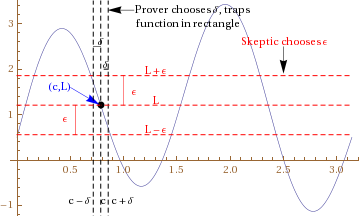
Slight subtlety regarding domain of definition: The domain of definition issue leads to a couple of minor subtleties:
- A priori, it is possible that the chosen by the skeptic is outside the domain of , so it does not make sense to evaluate . In the definition given above, this would lead to the game being won by the skeptic. In particular, if is not defined on the immediate left or right of , the skeptic can always win by picking outside the domain.
- It may make sense to restrict discussion to the cases where is defined on the immediate left or right of . Explicitly, we assume that is defined on the immediate left and immediate right, i.e., there exists such that is defined on the interval . In this case, it does not matter what rule we set regarding the case that the skeptic picks outside the domain. To simplify matters, we could alter the rules in any one of the following ways, and the meaning of limit would remain the same as in the original definition:
- We could require (as part of the game rules) that the prover pick such that . This pre-empts the problem of picking -values outside the domain.
- We could require (as part of the game rules) that the skeptic pick in the domain, i.e., pick with and .
- We could alter the rule so that if the skeptic picks outside the domain, the prover wins (instead of the skeptic winning).
{{#widget:YouTube|id=Kh253PUghFk}}
{{#widget:YouTube|id=N0U8Y11nlPk}}
Non-existence of limit
The statement does not exist could mean one of two things:
- is not defined around , i.e., there is no for which is defined on . In this case, it does not even make sense to try taking a limit.
- is defined around , around , i.e., there is for which is defined on . So, it does make sense to try taking a limit. However, the limit still does not exist.
The formulation of the latter case is as follows:
For every
, there exists
such that for every
, there exists
satisfying
and such that
.
We can think of this in terms of a slight modification of the limit game, where, in our modification, there is an extra initial move by the prover to propose a value for the limit. The limit does not exist if the skeptic has a winning strategy for this modified game.
An example of a function that does not have a limit at a specific point is the sine of reciprocal function. Explicitly, the limit:
does not exist. The skeptic's winning strategy is as follows: regardless of the chosen by the prover, pick a fixed (independent of , so can be decided in advance of the game -- note that the skeptic could even pick and the strategy would still work). After the prover has chosen a value , find a value such that the function value lies outside . This is possible because the interval has width , hence cannot cover the entire interval , which has width 2. However, the range of the function on is all of .
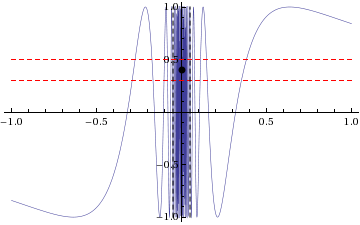
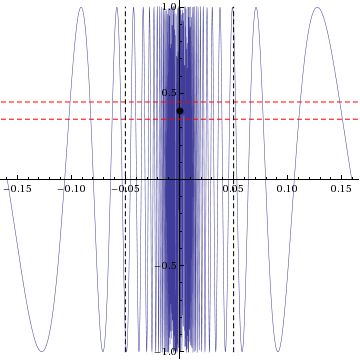
{{#widget:YouTube|id=JoVuC4pksWs}}
Conceptual definition and various cases
Formulation of conceptual definition
Below is the conceptual definition of limit. Suppose is a function defined in a neighborhood of the point , except possibly at the point itself. We say that:
if:
- For every choice of neighborhood of (where the term neighborhood is suitably defined)
- there exists a choice of neighborhood of (where the term neighborhood is suitably defined) such that
- for all that are in the chosen neighborhood of
- is in the chosen neighborhood of .
{{#widget:YouTube|id=bE_aKfmUHN8}}
Functions of one variable case
The following definitions of neighborhood are good enough to define limits.
- For points in the interior of the domain, for functions of one variable: We can take an open interval centered at the point. For a point , such an open interval is of the form . Note that if we exclude the point itself, we get .
- For the point , for functions of one variable: We take intervals of the form , where .
- For the point , for functions of one variable: We can take interval of the form , where .
We can now list the nine cases of limits, combining finite and infinite possibilities:
| Case |
Definition
|
|
For every , there exists such that for all satisfying (i.e., ), we have (i.e., ).
|
|
For every , there exists such that for all satisfying (i.e., ), we have (i.e., ).
|
|
For every , there exists such that for all satisfying (i.e., ), we have (i.e., ).
|
|
For every , there exists such that for all satisfying (i.e., ), we have (i.e., ).
|
|
For every , there exists such that for all satisfying (i.e., ), we have (i.e., ).
|
|
For every , there exists such that for all satisfying (i.e., ), we have (i.e., ).
|
|
For every , there exists such that for all satisfying (i.e., ), we have (i.e., ).
|
|
For every , there exists such that for all satisfying (i.e., ), we have (i.e., ).
|
|
For every , there exists such that for all satisfying (i.e., ), we have (i.e., ).
|
{{#widget:YouTube|id=EOQby7b-WrA}}
Limit of sequence versus real-sense limit
Fill this in later
Real-valued functions of multiple variables case
We consider the multiple input variables as a vector input variable, as the definition is easier to frame from this perspective.
The correct notion of neighborhood is as follows: for a point , we define the neighborhood parametrized by a positive real number as the open ball of radius centered at , i.e., the set of all points such that the distance from to is less than . This distance is the same as the norm of the difference vector . The norm is sometimes denoted . This open ball is sometimes denoted .
Suppose is a real-valued (i.e., scalar) function of a vector variable . Suppose is a point such that is defined "around" , except possibly at . In other words, there is an open ball centered at such that is defined everywhere on that open ball, except possibly at .
With these preliminaries out of the way, we can define the notion of limit. We say that:
if the following holds:
- For every
- there exists such that
- for all satisfying (i.e., is in a ball of radius centered at but not the point itself -- note that the notation is for the norm, or length, of a vector)
- we have . Note that and are both scalars, so the here is the usual absolute value function.
{{#widget:YouTube|id=HZcYxcZplFA}}

