Quadratic function: Difference between revisions
No edit summary |
|||
| Line 17: | Line 17: | ||
|- | |- | ||
| [[range]] || Case <math>a > 0</math>: <math>\left[c - \frac{b^2}{4a},\infty\right)</math><br>Case <math>a < 0</math>: <math>\left(-\infty,c - \frac{b^2}{4a}\right]</math> | | [[range]] || Case <math>a > 0</math>: <math>\left[c - \frac{b^2}{4a},\infty\right)</math><br>Case <math>a < 0</math>: <math>\left(-\infty,c - \frac{b^2}{4a}\right]</math> | ||
|- | |||
| [[period]] || not a periodic function | |||
|- | |||
| [[local maximum value]] and points of attainment || Case <math>a > 0</math>: No local maximum value<br>Case <math>a < 0</math>: local maximum value <math>c - \frac{b^2}{4a}</math> is attained at point <math>\frac{-b}{2a}</math>. | |||
|- | |||
| [[local minimum value]] and points of attainment || Case <math>a > 0</math>: local maximum value <math>c - \frac{b^2}{4a}</math> is attained at point <math>\frac{-b}{2a}</math>.<br>Case <math>a < 0</math>: no local maximum value | |||
|- | |||
| [[point of inflection|points of inflection]] || None | |||
|- | |||
| [[derivative]] || The [[linear function]] <math>x \mapsto 2ax + b</math> | |||
|- | |||
| [[second derivative]] || The [[constant function]] with constant value <math>2a</math> | |||
|- | |||
| <math>n^{th}</math> derivative || The first and second derivative are as described above. All higher derivatives are zero. | |||
|- | |||
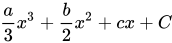
| [[antiderivative]] || <math>\frac{a}{3}x^3 + \frac{b}{2}x^2 + cx + C</math> with <math>C \in \R</math>. | |||
|- | |||
| important symmetry || The graph of the function has mirror symmetry about the line <math>x = -b/2a</math> (the vertical line through the unique critical point) | |||
|- | |||
| interval description based on increase/decrease and concave up/down || Case <math>a < 0</math>:<br>increasing and concave down on <math>\left(-\infty,\frac{-b}{2a}\right]</math><br>decreasing and concave down on <math>\left[\frac{-b}{2a},\infty\right)</math><br>Case <math>a > 0</math>:<br>decreasing and concave up on <math>\left(-\infty,\frac{-b}{2a}\right]</math><br>increasing and concave up on <math>\left[\frac{-b}{2a},\infty\right)</math> | |||
|- | |||
| [[power series]] and [[Taylor series]] || The power series is the same as the polynomial, i.e., the power series about any point simplifies to the polynomial <math>ax^2 + bx + c</math> (written in increasing order of powers of <math>x</math> as <math>c + bx + ax^2</math>) | |||
|} | |} | ||
Revision as of 15:13, 11 May 2014
Definition
A quadratic function is a function of the form:

where are real numbers and . In other words, a quadratic function is a polynomial function of degree two.


Unless otherwise specified, we consider quadratic functions where the inputs, outputs, and coefficients are all real numbers.
Key data
| Item | Value |
|---|---|
| Default domain | all real numbers, i.e., all of |
| range | Case : Case : |
| period | not a periodic function |
| local maximum value and points of attainment | Case : No local maximum value Case : local maximum value is attained at point . |
| local minimum value and points of attainment | Case : local maximum value is attained at point . Case : no local maximum value |
| points of inflection | None |
| derivative | The linear function |
| second derivative | The constant function with constant value |
| derivative | The first and second derivative are as described above. All higher derivatives are zero. |
| antiderivative | with . |
| important symmetry | The graph of the function has mirror symmetry about the line (the vertical line through the unique critical point) |
| interval description based on increase/decrease and concave up/down | Case : increasing and concave down on decreasing and concave down on Case : decreasing and concave up on increasing and concave up on |
| power series and Taylor series | The power series is the same as the polynomial, i.e., the power series about any point simplifies to the polynomial (written in increasing order of powers of as ) |


![{\displaystyle \left(-\infty ,c-{\frac {b^{2}}{4a}}\right]}](https://wikimedia.org/api/rest_v1/media/math/render/svg/1721eacfac93cc6efcb5216a775451999ea23f73)




![{\displaystyle \left(-\infty ,{\frac {-b}{2a}}\right]}](https://wikimedia.org/api/rest_v1/media/math/render/svg/8c278d24b40c7c375dbd4df6c61cb318d59ab9ea)


Key invariants
| Expression | Name | Significance in the case |
|---|---|---|
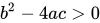
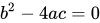
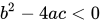
| (unnormalized) discriminant | The discriminant is positive (i.e., ) iff the quadratic has two distinct real roots The discriminant is zero (i.e., ) iff the quadratic has a real root of multiplicity two The discriminant is negative (i.e., ) iff the quadratic has no real roots | |
| leading coefficient | Leading coefficient is positive (i.e., ) iff that the function approaches infinity as and as Leading coefficient is negative (i.e., ) iff that the function approaches infinity as and as | |
| sum of roots | If the roots are (counted with multiplicity, and they need not be real roots), then the polynomial is and the sum of roots is . | |
| product of rots | If the roots are (counted with multiplicity, and they need not be real roots), then the polynomial is and the product of roots is . | |
| normalized discriminant | Similar observations as for the discriminant. |