Lagrange mean value theorem: Difference between revisions
(→Proof) |
(→Proof) |
||
| Line 42: | Line 42: | ||
| 4 || <math>g</math> is differentiable on <math>(a,b)</math> || Fact (2) || <math>f</math> is differentiable on <math>(a,b)</math> || Steps (1), (2) || <toggledisplay>By Step (2), <math>g = f - h</math>. By Step (1), <math>h</math> is linear and hence differentiable on <math>(a,b)</math>. Thus, by Fact (1), <math>g = f - h</math>, being the difference of two differentiable functions, is differentiable on <math>(a,b)</math>.</toggledisplay> | | 4 || <math>g</math> is differentiable on <math>(a,b)</math> || Fact (2) || <math>f</math> is differentiable on <math>(a,b)</math> || Steps (1), (2) || <toggledisplay>By Step (2), <math>g = f - h</math>. By Step (1), <math>h</math> is linear and hence differentiable on <math>(a,b)</math>. Thus, by Fact (1), <math>g = f - h</math>, being the difference of two differentiable functions, is differentiable on <math>(a,b)</math>.</toggledisplay> | ||
|- | |- | ||
| 5 || <math> | | 5 || <math>g(a) = g(b) = 0</math> || || || Steps (1), (2) || <toggledisplay><math>h(a) = f(a)</math> yields <math>g(a) = 0</math>. <math>h(b) = f(b)</math> yields <math>g(b) = 0</math>.</toggledisplay> | ||
|- | |- | ||
| 6 || There exists <math>c \in (a,b)</math> such that <math>\!g'(c) = 0</math>. || Fact (3) || || Steps (3), (4), (5) || <toggledisplay>Steps (3), (4), (5) together show that <math>g</math> satisfies the conditions of Rolle's theorem on the interval <math>[a,b]</math>, hence we get the conclusion of the theorem.</toggledisplay> | | 6 || There exists <math>c \in (a,b)</math> such that <math>\!g'(c) = 0</math>. || Fact (3) || || Steps (3), (4), (5) || <toggledisplay>Steps (3), (4), (5) together show that <math>g</math> satisfies the conditions of Rolle's theorem on the interval <math>[a,b]</math>, hence we get the conclusion of the theorem.</toggledisplay> | ||
Latest revision as of 20:19, 20 October 2011
Statement
Suppose is a function defined on a closed interval (with ) such that the following two conditions hold:

![{\displaystyle [a,b]}](https://wikimedia.org/api/rest_v1/media/math/render/svg/9c4b788fc5c637e26ee98b45f89a5c08c85f7935)

- is a continuous function on the closed interval (i.e., it is right continuous at , left continuous at , and two-sided continuous at all points in the open interval ).
- is a differentiable function on the open interval , i.e., the derivative exists at all points in . Note that we do not require the derivative of to be a continuous function.


Then, there exists in the open interval such that the derivative of at equals the difference quotient . More explicitly:


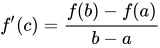
Geometrically, this is equivalent to stating that the tangent line to the graph of at is parallel to the chord joining the points and .


Note that the theorem simply guarantees the existence of , and does not give a formula for finding such a (which may or may not be unique).
Related facts
- Rolle's theorem
- Zero derivative implies locally constant
- Fundamental theorem of calculus
- Positive derivative implies increasing
- Increasing and differentiable implies nonnegative derivative
- Derivative of differentiable function on interval satisfies intermediate value property
Facts used
- Continuous functions form a vector space
- Differentiable functions form a vector space
- Rolle's theorem
- Differentiation is linear
Proof
| Step no. | Assertion/construction | Facts used | Given data used | Previous steps used | Explanation |
|---|---|---|---|---|---|
| 1 | Consider the function . Then, is a linear (and hence a continuous and differentiable) function with and |
Just plug in and check. Secretly, we obtained by trying to write the equation of the line joining the points and . | |||
| 2 | Define on , i.e., . | ||||
| 3 | is continuous on | Fact (1) | is continuous on | Steps (1), (2) | [SHOW MORE] |
| 4 | is differentiable on | Fact (2) | is differentiable on | Steps (1), (2) | [SHOW MORE] |
| 5 | Steps (1), (2) | [SHOW MORE] | |||
| 6 | There exists such that . | Fact (3) | Steps (3), (4), (5) | [SHOW MORE] | |
| 7 | For the obtained in step (6), | Fact (4) | Steps (2), (6) | [SHOW MORE] | |
| 8 | for all . In particular, . | Step (1) | Differentiate the expression for from Step (1). | ||
| 9 | Steps (7), (8) | Step-combination direct |





